Colombia Banknote Catalog
The Beginnings of Paper Money in Colombia
The history of paper money in Colombia began during the Independence period, marked by the urgency of war, a shortage of precious metals, and the population’s initial rejection of notes. The stages below trace the first years of banknote printing in the country.
1. Provincial Emergency Issues (1811–1813)
Before a centralized banking system existed, the provinces that declared independence from Spain issued Colombia’s first banknotes to finance their armies.
- Cartagena (1811–1813): was the pioneering province. Faced with a shortage of silver and gold, the State of Cartagena authorized the first fiduciary paper-money issues in denominations of reales. These banknotes were printed very crudely on ordinary paper and signed by hand by patriot leaders such as the Piñeres brothers.
- Cundinamarca (1814): following Cartagena’s example, the State of Cundinamarca issued its own “vales” or notes of the Tesorería General in Bogotá to sustain the war against the royalists.
- The initial failure: a population used to the intrinsic value of gold and silver coin deeply mistrusted these papers. With the Spanish Reconquista in 1815, most of these banknotes were burned or destroyed, and they are today pieces of extreme numismatic rarity.
2. The Republic of Gran Colombia (1819–1831)
After Simón Bolívar’s decisive victory at the Battle of Boyacá (1819), Gran Colombia was founded.
- During this period the government issued Vales of the Tesorería General de la República to pay the debts of the war of independence.
- Although the formal creation of a national bank that would issue banknotes in an organized way was discussed, political instability and the dissolution of Gran Colombia in 1830 postponed the project.
3. The Era of Private and Free Banking (1870–1885)
In the mid-nineteenth century the Colombian economy still ran mainly on gold and silver coin and on foreign coins. The true boom and regularization of modern paper money arrived in the 1870s.
- Banco de Bogotá (1870): was the first successful private bank to issue banknotes in the country. Backed by real reserves and the confidence of local commerce, these notes were accepted on a large scale.
- A multiplicity of issuers: after the success of Banco de Bogotá, an era of “free banking” (banca libre) opened. Dozens of private banks in different regions (such as Banco de Antioquia, Banco de Colombia, and Banco de Bolívar) printed their own banknotes, manufactured to high security standards by foreign firms (mainly in New York and London).
4. Banco Nacional and “Curso Forzoso” (1880–1903)
In 1880, under the presidency of Rafael Núñez, Banco Nacional was founded, the state’s first attempt to centralize the issue of money.
- La Regeneración: in 1886 the government decreed the “curso forzoso” (forced legal tender / compulsory circulation) of Banco Nacional banknotes, forbidding demands for payment in gold and gradually eliminating the private banks’ right of issue.
- The crisis of the Thousand Days’ War (1899–1902): to finance this devastating civil conflict, the government printed banknotes without control. The result was one of the worst hyperinflations in Colombian history: paper money lost almost all of its value and Banco Nacional had to be liquidated.
5. Consolidation: Banco de la República (1923)
To restore the economy and public confidence, the Kemmerer Mission was hired in 1923 (a group of U.S. financial experts led by Edwin Walter Kemmerer).
- Foundation: on 23 July 1923 Banco de la República was founded and received the exclusive, definitive right to issue legal-tender paper money in Colombia.
- The first Banco de la República banknotes were, in fact, provisional notes overprinted from the old Casa de Moneda de Medellín, until the first official series commissioned from the American Bank Note Company arrived. From then on, issue of the Colombian peso was fully centralized and stabilized.
Colombian Issues Printed Abroad
El Banco Colombiano, founded by Colombian investors and established in Guatemala, issued its own paper money outside the country’s borders —a separate chapter of Colombian banking history abroad.
See the Issues Printed Abroad catalog →Banknotes of the Last Century
Colombia Banknote Catalog

United States of New Granada (1861)

United States of Colombia


Sovereign states (1882)


Free Banking
El Banco Hipotecario

El Banco de Rio Hacha

El Banco del Cauca


El Banco de Medellín
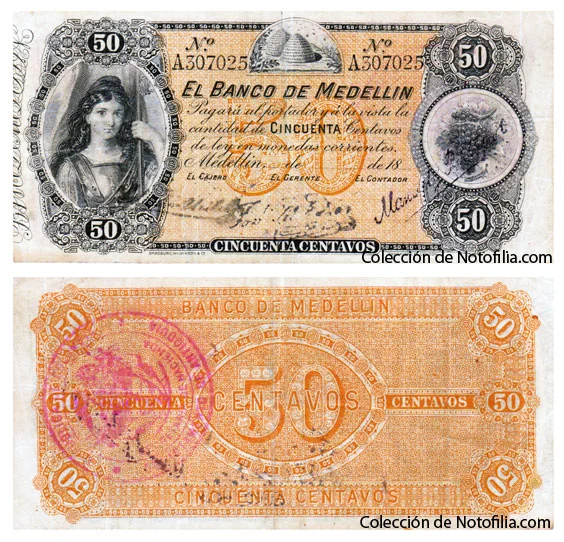
El Banco de Pamplona


El Banco del Norte

El Banco de la Unión


El Banco Internacional


Vicente B. Villa é Hijos

El Banco Unión

El Banco de Panamá


El Banco de Oriente

Banco de Antioquia

El Banco de Barranquilla

El Banco de Caldas

El Banco de Colombia

Departamento de Antioquia

El Banco Nacional

Republic of Colombia


State Public Debt
Fiscal bonds and warrants

Banco de la República Banknotes (From 1923)
1/2 Peso

1 Peso

2 Pesos

5 Pesos

10 Pesos


50 Pesos

100 Pesos

200 Pesos

500 Pesos

1000 Pesos

2000 Pesos
-
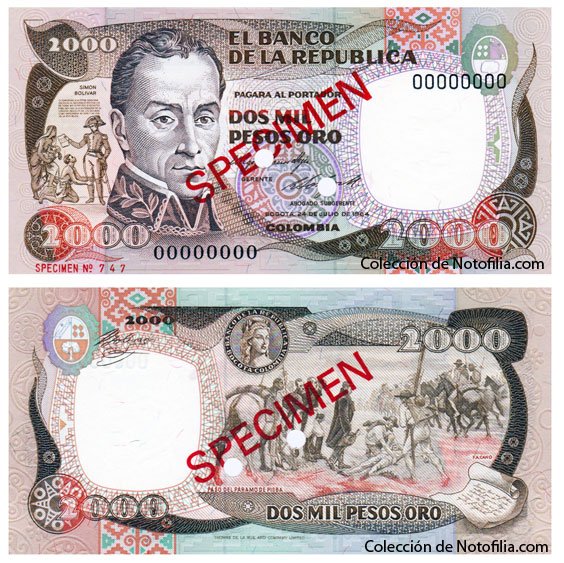 1984–1993 Dos Mil Pesos Oro El Banco de la República
 -
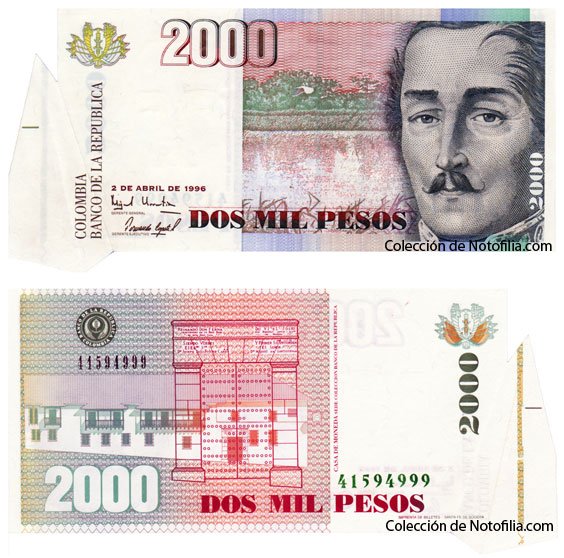 1996 Dos Mil Pesos — Corte Descentrado El Banco de la República
 -
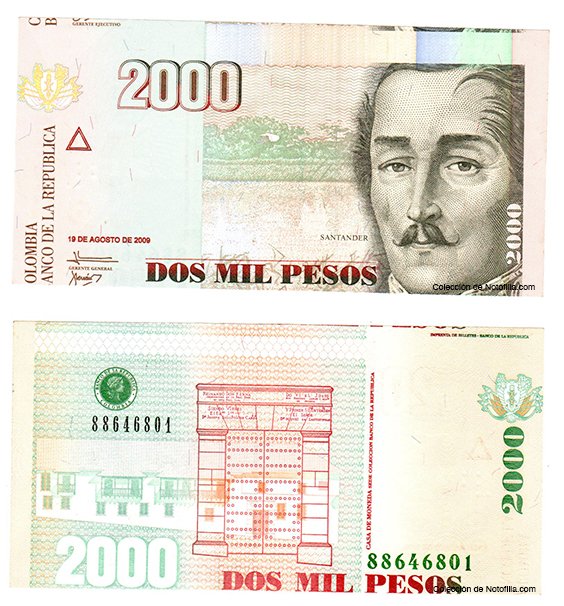 2005, 2009 Dos Mil Pesos — Corte Descentrado El Banco de la República
 -
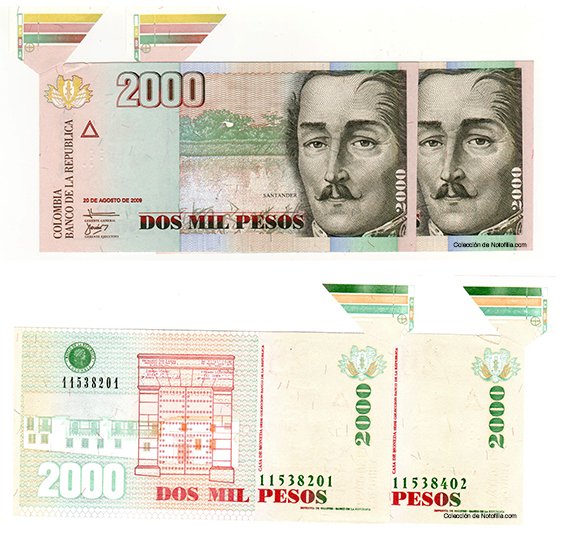 2009 Dos Mil Pesos — Corte “Mariposa” El Banco de la República
 -
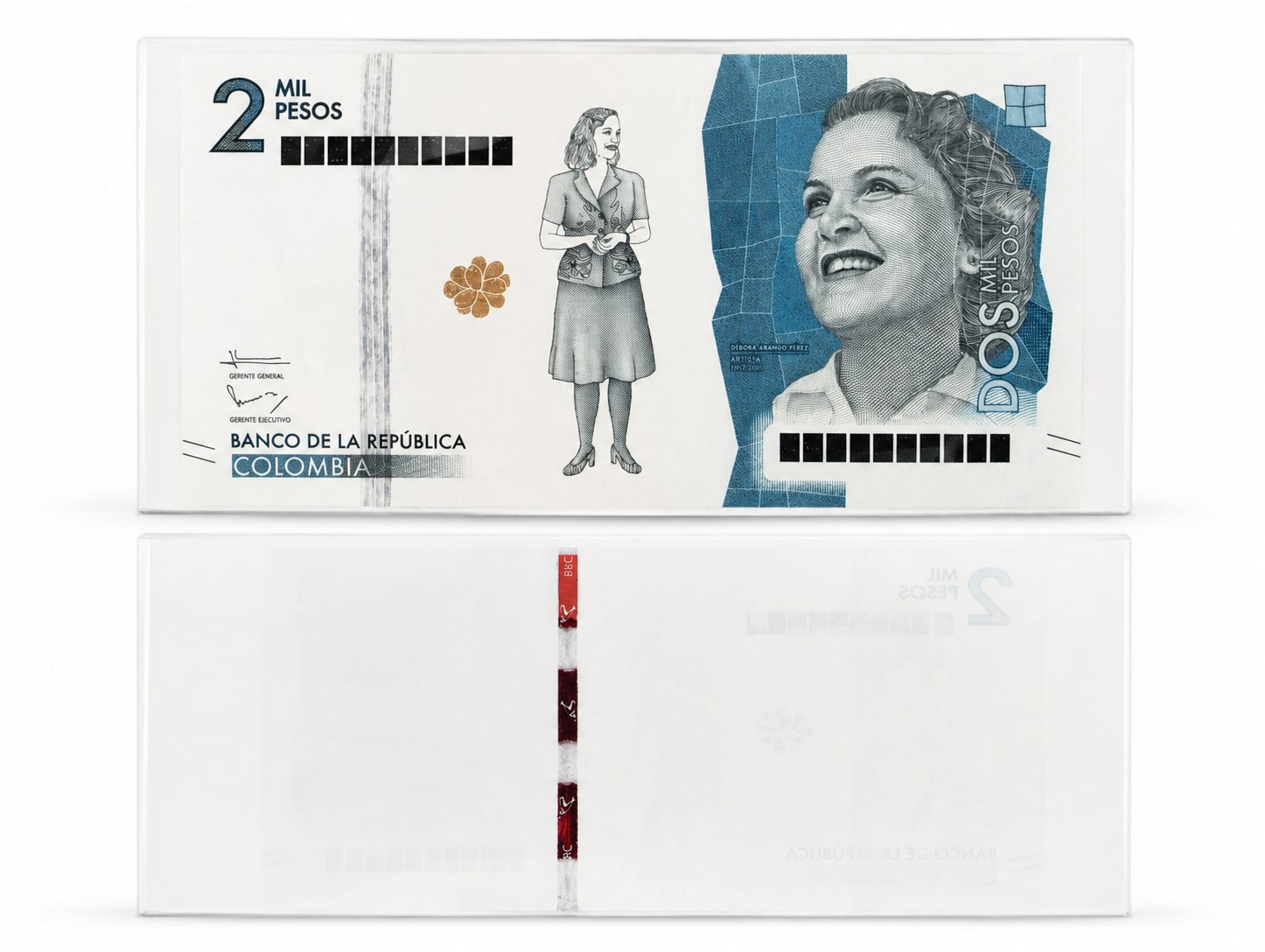 2.08.2016 Two Thousand Pesos — Débora Arango (P-458b proof) El Banco de la República
 -
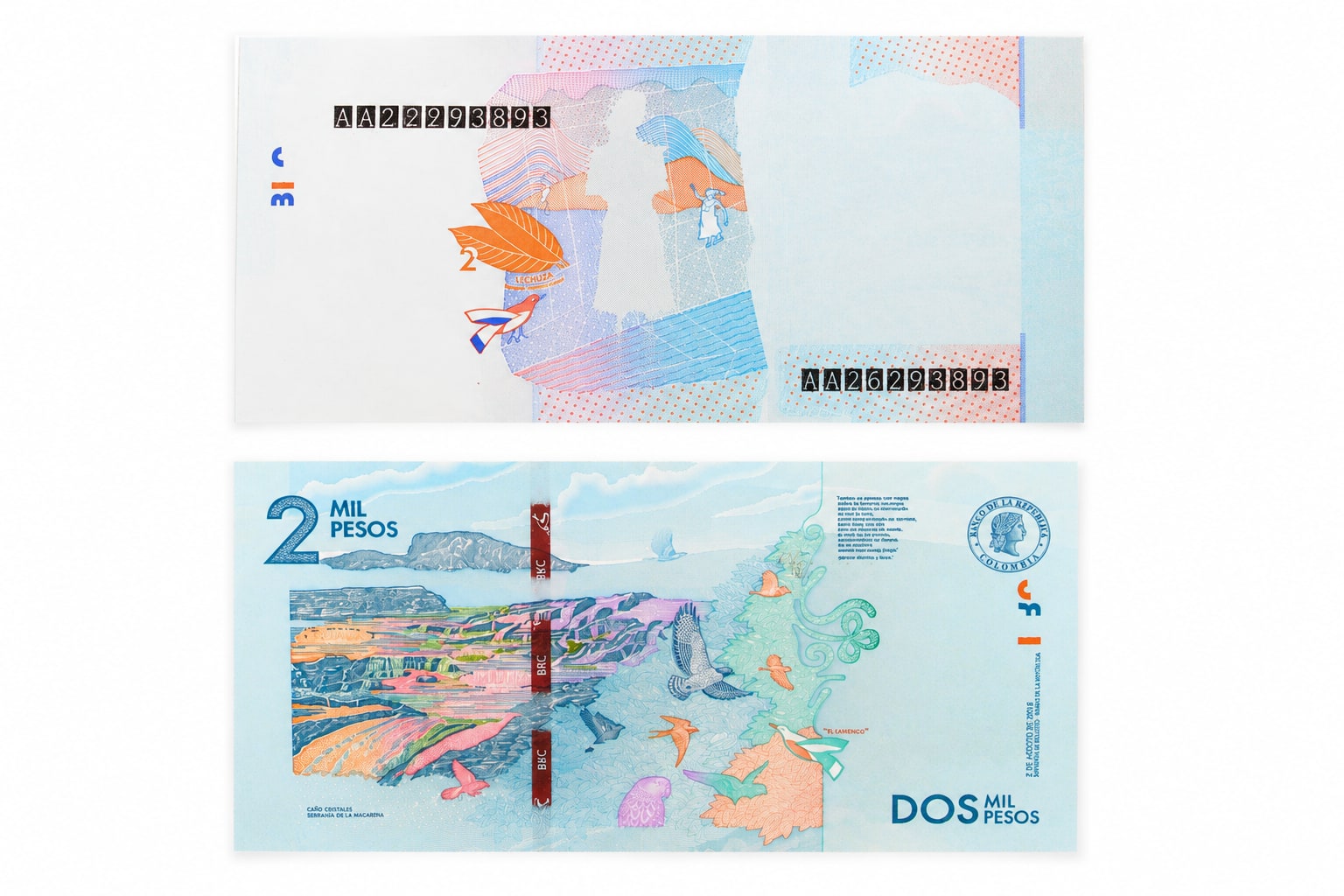 2.08.2016 Two Thousand Pesos — Débora Arango (P-458b face proof) El Banco de la República


