The Bank of Medellin
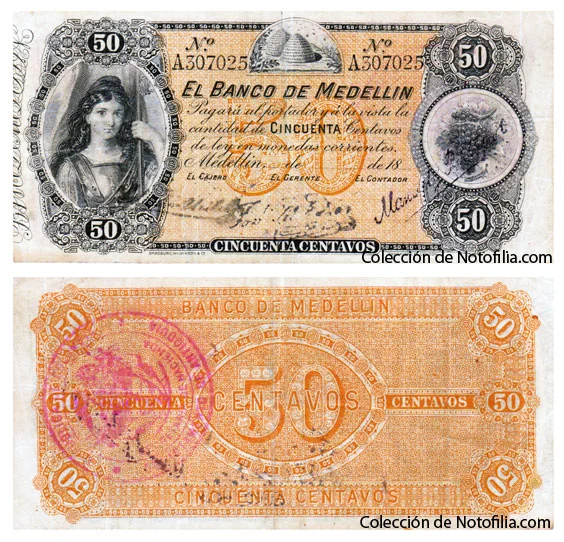
Fifty Cents · Series A, N.° A307025
Historical and Issue Context
One of the banks of banking-era Medellín:The Banco de Medellín was part of the first generation of private banks that emerged in Antioquia after the founding, in 1872, of the Banco de Antioquia —, the first in the region, of a semi-official nature. By 1884 the city already had about a dozen of its own banking entities, among them the Banco de Antioquia, the Banco Popular de Medellín, the Banco del Progreso, the Banco de Oriente and the Banco de Medellín itself, along with commercial-banking houses such as Vicente B. Villa é Hijos and Botero Arango é Hijos.1
Among the most far-reaching entities:unlike the family commercial houses that also issued their own banknotes, the Bank of Medellín was constituted as a banking company properly speaking. Studies on banking penetration in Antioquia place Banco de Antioquia and Banco de Medellín among the entities with the largest number of customers in the region, in contrast to more family-oriented houses with limited reach such as Vicente B. Villa é Hijos.2
Medellín in the era of gold and commerce:The Antioquia banking boom of the 1870s and 1880s was closely linked to gold mining and the region's import-export trade, which generated the capital and commercial confidence necessary to sustain the private issuance of paper money as a complement to the scarce metallic currency in circulation.
Key Details Visible on the Banknote
- Left vignette:bust portrait of a woman within an ornamental oval, framed by a decorative border —a common iconographic device on 19th-century Colombian banknotes.
- Upper central vignette:a beehive flanked by olive branches, a classic symbol of industriousness and thrift frequently seen in 19th-century banknote iconography.
- Right vignette:Circular medallion with a bunch of grapes, in dark ink on an engraved background.
- Text of the obligation:“Shall pay to bearer and sight the amount of Fifty Cents in ordinary coins,” with the handwritten signatures of the Cashier, Manager, and Accountant, and the typographic watermark “50” superimposed on the design.
- Numbering:“N.° A307025” repeated in both top corners, with the series printed next to the header “EL BANCO DE MEDELLIN”.
- Reverse:complete geometric guilloche in orange ink, with the value “50” and the legend “FIFTY CENTS” repeated on the medallions, and a circular seal in pink ink superimposed on the design, partially illegible.
Additional Context
This specimen, without a date completed, is representative of the profusion of regional banks that characterized Antioquia during the era of free banking —a system that the Regeneration of 1886 would end up centralizing, decades before the Bank of the Republic assumed in 1923 the absolute monopoly of monetary issuance in Colombia.
Notes
1. “Currency and Banking in Antioquia — Colombia in the Late Nineteenth Century”,Revista de Historia Económica y Social. Available at scielo.org.co.
2. Botero Herrera, María Mercedes. “Banking Institutions in Antioquia, 1872–1886.”Economics Readings, n.° 17, Medellín, May–agosto de 1985, pp. 43–147.